Is This SMS a Scam?
A Bag of Words compares each message with the average scam and the average genuine message — and learns why a real bank alert is the hardest thing to tell apart from a fake one.
1Introduction
Almost everyone in India now gets scam messages: "You have won Rs 25 lakh", "Your KYC is pending, your account will be blocked", "Pay Rs 500 to confirm your job". Some people believe them and lose money or share an OTP.
The hard part is that real messages look similar. A real bank sends "Rs 2,999 debited from your account"; a scammer sends the same words with a phone number to call. Blocking every message about money would block the alerts people need.
This project reads a message and decides whether it looks like a scam, using the Bag of Words from Unit 6.
Peace, Justice and Strong Institutions
Industry, Innovation and Infrastructure
SDG 16 includes reducing crime and fraud of every kind, and SDG 9 asks that people can safely use the digital services now built for them. Scam messages — fake prizes, fake KYC alerts, fake job offers — cheat thousands of people in India every day, often those newest to mobile banking. A warning on the message itself, before anyone clicks or pays, is one of the best defences.
The curriculum asks that the project be related to the Sustainable Development Goals. That link is the reason the problem is worth solving, so it belongs at the very start of the report, not tacked on at the end.
2Stage 1 — Problem Scoping
Problem scoping means understanding the problem properly before building anything. The tool for it is the 4Ws Problem Canvas: who has the problem, what the problem is, where it happens, and why solving it matters.
- Mobile phone users, especially the elderly and first-time users
- Banks and phone companies, who are blamed when customers are cheated
- Scam messages trick people into paying or sharing an OTP
- Real alerts look like scams, so blocking everything is not an answer
- On every mobile phone
- At any time — scams often say "today" or "now" to rush people
- A warning at the right moment can stop a fraud
- People can trust the genuine messages they receive
The problem statement
The four answers are then joined into one sentence, using the curriculum's problem statement template:
Mobile phone users — especially grandparents and first-time smartphone users — and the makers of SMS and messaging apps.
How it is done today
They catch a lot, mostly by blocking known senders. New scams from new numbers get through.
Banks and the government warn people never to share an OTP. Very important, but it relies on the person remembering at the moment of reading.
Simple, but genuine delivery, school and bank messages also contain links.
Objectives
- To read a set of labelled SMS messages from a CSV file
- To normalise the text, turning every link into "link" and every number into "number"
- To build a Bag of Words table for all the messages
- To find the words that give a scam away
- To build a model that compares each message with the average scam and the average genuine message
- To evaluate it, look at its mistakes, and choose a threshold
📘 Revise: Stage 1 — Problem Scoping
3Stage 2 — Data Acquisition
Each row is one SMS with a label: scam or genuine.
The file has 481 rows. Every web link in it uses the reserved .example domain, so none points to a real website, and every phone number is made up.
The messages were written by a program in the styles common in India — including scams dressed up as bank alerts, and genuine messages that sound urgent — so no real person's messages are used. For your own project, never collect other people's messages. Use a public SMS spam dataset (and credit it), or write examples yourself from the warnings your bank publishes.
Features and label
The features are what the model is given. The label is the answer it has to learn to give.
| Column | Type | What it holds | Role |
|---|---|---|---|
text | text | The message — turned into tokens and a Bag of Words | feature |
label | text | scam or genuine — what the model must predict | label |
sms_id | text | An ID for the message | not used |
The first six rows of sms_messages.csv
| sms_id | text | label |
|---|---|---|
M10001 | You have won a free iPhone! Send your address and Rs 2,999 delivery charge to 9547699478 | scam
|
M10002 | Rs 75 debited from your account XX5241. If this was not you, call 9355398793 to cancel | scam
|
M10003 | FREE recharge offer for you! Get Rs 2,999 talktime, click http://kyc-update.example/verify before midnight | scam
|
M10004 | 4610 is your OTP for login. Do not share it with anyone. It is valid for 10 minutes | genuine
|
M10005 | URGENT: your electricity will be cut tonight as bill is unpaid. Call officer 9967193435 immediately | scam
|
M10006 | Reminder: your library book is due back on Monday | genuine
|
Inside sms_messages.csv
Scam and genuine text messages. One message was stored twice. The whole file is 481 rows, 46.8 KB. It comes with the project download, and you can take the file on its own.
📘 Revise: Stage 2 — Data Acquisition
4Stage 3 — Data Exploration
Data exploration means getting to know the data before trusting it: fixing what is wrong with it, then drawing it to see the patterns. The charts here are what decide what the model should be.
What was wrong with the data
Removed with drop_duplicates().
The exact address does not matter, but having a link does. So every word starting with http becomes the single token link.
Amounts, phone numbers and OTPs are all different. A run of digits becomes the single token number, so "Rs 25,00,000" becomes rs number.
Everything is changed to lower case and punctuation is removed, as in any text normalisation. Stop words are removed too.
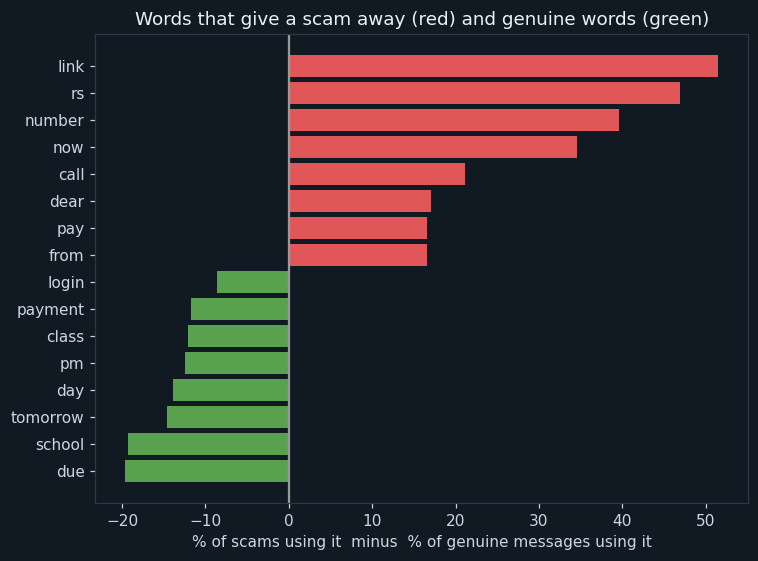
For each word: the share of scams that use it, minus the share of genuine messages that use it. Red words lean towards scam, green words towards genuine.
The strongest scam signs are link, rs, number, now and call. A link appears in about half the scams and in no genuine message at all. The genuine words are everyday ones — due, school, tomorrow, class, login.
Notice that rs and number also appear in many genuine messages. Bank alerts are full of amounts. That overlap is where the model will make its mistakes.
📘 Revise: Stage 3 — Data Exploration
5Stage 4 — Modelling
Where this model sits in the family of AI models:
The answer is scam or genuine, so this is classification. The training messages are labelled, so it is supervised learning, in the NLP domain.
How the model works
Every message becomes a row of the Bag of Words table: one column for each of the 158 words in the vocabulary, holding how many times that word appears in the message.
The messages are split into 384 for training and 96 for testing. From the training messages the model builds two average rows: the average scam and the average genuine message.
To judge a message, it measures how similar the message is to each average, using cosine similarity — a number from 0 (no words in common) to 1 (exactly the same mix of words). If the message is more similar to the average scam than to the average genuine message by more than the threshold, it is flagged. The threshold starts at 0.
📘 Revise: Stage 4 — Modelling
6Stage 5 — Evaluation
On 96 testing messages the accuracy was 87.5 %, with recall 100.0 % and precision 78.2 %. Every scam was caught.
The mistakes are printed in the output, and every one is a genuine bank alert — money credited or debited, with an amount and a call to the bank. These share rs, number, account and call with the scams. That is not a fault in the program so much as a fact about scams: they are written to look exactly like these alerts.
Here, both mistakes matter. A missed scam can empty a bank account. But a genuine alert marked as a scam may never be read — and that alert might be the warning that a real fraud is happening. So this project uses the F1 score, which balances precision and recall, to choose the threshold. Raising it from 0 to 0.05 gives the best balance.
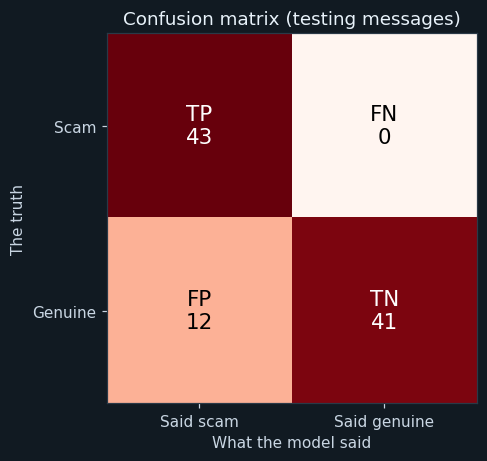
Scam is the positive class. TP: scam and flagged. FN: scam but missed. FP: genuine but flagged. TN: genuine and passed.
On the testing messages the counts are 43 0 12 41 (TP, FN, FP, TN). No scam was missed, but some genuine messages were flagged.
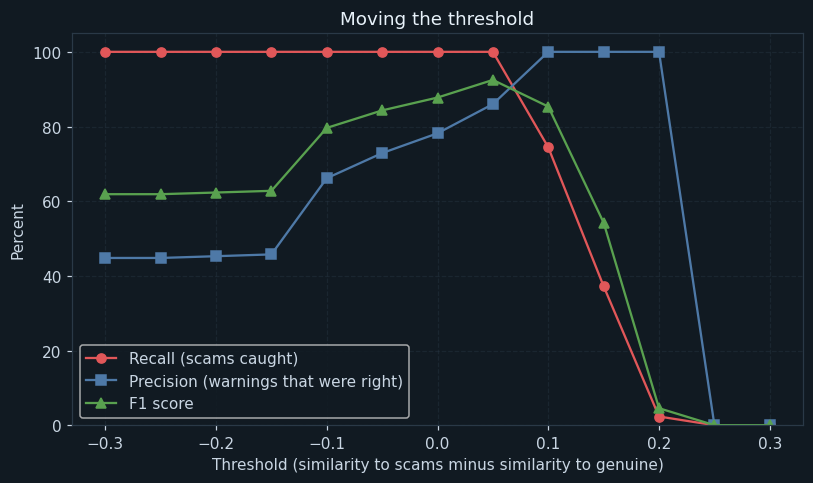
Across: the threshold. A message is a scam if its similarity to the average scam is higher than its similarity to the average genuine message by more than this amount. Red is recall, blue precision, green the F1 score.
At low thresholds every scam is caught but many genuine messages are flagged. As the threshold rises, fewer genuine messages are flagged, until scams start to slip through. The F1 score, which balances the two, is highest at 0.05, where it reaches 92.5 %.
📘 Revise: The Confusion Matrix
7Stage 6 — Deployment
The program checks four new messages: a genuine OTP, a fake KYC alert, a message from a child to a parent, and a fake prize. It warns about the two scams and passes the other two.
In a messaging app, a flagged message would not be deleted — it would carry a clear warning: "This looks like a scam. Never share an OTP or pay to claim a prize." The user still sees every message and decides.
📘 Revise: Stage 6 — Deployment
8Ethical concerns
An AI project is not finished when the model works. The curriculum asks three questions of every model — is it fair (bias), can it explain itself (transparency), and who answers for its mistakes (accountability). For this project:
A false positive could hide a genuine bank alert. Flagged messages should be marked with a warning, never deleted, so the user always has the final say.
Messages are private. A real filter should check messages on the phone itself, without sending them anywhere, and must never be trained on people's messages without their permission.
The model knows English scams in the styles it was shown. Scams in Hindi or other Indian languages, or a new trick, would get through. It must be updated as scams change.
This dataset uses made-up numbers and reserved .example links, so it cannot direct anyone to a real scam.
📘 Revise: Bias, Transparency, Accountability
9Source code
The whole program — it is also in the downloads at the top of this page — in Python with pandas, NumPy and matplotlib — the three libraries of Unit 7. It is laid out as the six stages of the AI Project Cycle, one after another. Every chart on this page was drawn by it, and every number came out of running it.
# ---------------------------------------------------------------------------
# scam_sms.py
#
# AI project on Natural Language Processing: spotting scam text messages -
# fake prizes, fake KYC alerts, fake job offers - before someone is cheated.
#
# CBSE Class X, Artificial Intelligence (417), Part C project work.
# SDG 16 (Peace, Justice and Strong Institutions) and SDG 9 (Industry,
# Innovation and Infrastructure).
#
# Each message is turned into a BAG OF WORDS: how many times each word of
# the vocabulary appears in it. The model then builds two "average messages"
# from the training data - an average scam and an average genuine message -
# and asks of each new message: which average does it share more words with?
#
# How much two messages share is measured with cosine similarity:
#     similarity = (sum of count1 x count2 over every word)
#                  / (length of message 1 x length of message 2)
# It is 1 for messages with exactly the same mix of words and 0 for messages
# with no word in common.
#
# Libraries: pandas (the messages), numpy (the arithmetic), matplotlib.
# ---------------------------------------------------------------------------

# %% Stage 1 - Problem scoping
print("=" * 60)
print("IS THIS SMS A SCAM?")
print("=" * 60)
print("Who   : mobile phone users, especially the elderly and first-time users")
print("What  : scam messages trick people into paying or sharing an OTP")
print("Where : on every phone, every day")
print("Why   : a warning at the right moment can stop a fraud")
print()

# %% Stage 2 - Data acquisition
import pandas as pd
import numpy as np
import matplotlib.pyplot as plt

pd.set_option("display.width", 140)
pd.set_option("display.max_colwidth", 100)

data = pd.read_csv("sms_messages.csv")

print("--- Stage 2: Data acquisition ---")
print("Messages read :", len(data))
print()
print(data.head(6).to_string(index=False))
print()

# %% Stage 3 - Data exploration
print("--- Stage 3: Data exploration ---")
before = len(data)
data = data.drop_duplicates()
print("Messages stored twice :", before - len(data), "(removed)")
print("Messages left         :", len(data))
print(data["label"].value_counts().to_string())
print()

stop_words = ["the", "a", "an", "is", "are", "to", "for", "of", "in", "on", "at", "your",
              "you", "it", "and", "with", "be", "will", "has", "have", "been", "this", "we",
              "our", "my", "me", "i", "or", "us", "if"]

# Text normalisation. Two extra steps for SMS: a web link becomes the
# single word "link", and any run of digits becomes the word "number" -
# the exact link or number does not matter, but having one does.
tokens_list = []
for text in data["text"]:
    words = []
    for raw in text.lower().split():
        if raw.startswith("http"):
            words.append("link")
            continue
        clean = ""
        previous_digit = False
        for ch in raw:
            if ch.isdigit():
                if not previous_digit:          # a run of digits is one "number"
                    clean = clean + " number "
                previous_digit = True
                continue
            previous_digit = False
            if ch.isalpha():
                clean = clean + ch
            elif ch != ",":                     # 25,00,000 is still one number
                clean = clean + " "
        for w in clean.split():
            if w not in stop_words:
                words.append(w)
    tokens_list.append(words)
data["tokens"] = tokens_list

print("Text normalisation of one message:")
print("  Original :", data.iloc[0]["text"])
print("  Tokens   :", data.iloc[0]["tokens"])
print()

vocabulary = []
for tokens in data["tokens"]:
    for w in tokens:
        if w not in vocabulary:
            vocabulary.append(w)
print("Words in the vocabulary :", len(vocabulary))

# The Bag of Words: one row per message, one column per vocabulary word.
bow = np.zeros((len(data), len(vocabulary)))
for m in range(len(data)):
    for w in data.iloc[m]["tokens"]:
        bow[m, vocabulary.index(w)] = bow[m, vocabulary.index(w)] + 1
print("Bag of Words table size  :", bow.shape[0], "messages x", bow.shape[1], "words")
print()

# Which words are most typical of each kind? (share of messages using them)
is_scam = (data["label"] == "scam").values
scam_share = (bow[is_scam] > 0).mean(axis=0) * 100
genuine_share = (bow[~is_scam] > 0).mean(axis=0) * 100
words = pd.DataFrame({"scam %": scam_share, "genuine %": genuine_share}, index=vocabulary)
words["difference"] = words["scam %"] - words["genuine %"]
top = words.sort_values("difference")
print("Words most typical of scams:")
print(top.tail(6)[::-1].round(1))
print()

# Chart 1: the words most typical of scams and of genuine messages.
pick = pd.concat([top.head(8), top.tail(8)])
plt.figure(figsize=(7, 5.2))
colours = []
for v in pick["difference"]:
    if v > 0:
        colours.append("#e15759")
    else:
        colours.append("#59a14f")
plt.barh(pick.index, pick["difference"], color=colours)
plt.axvline(0, color="#999999")
plt.title("Words that give a scam away (red) and genuine words (green)")
plt.xlabel("% of scams using it  minus  % of genuine messages using it")
plt.tight_layout()
plt.savefig("chart1_telltale_words.png")
plt.close()

# %% Stage 4 - Modelling
print("--- Stage 4: Modelling ---")
order = np.random.default_rng(3).permutation(len(data))
cut = int(len(data) * 0.8)
train_rows = order[:cut]
test_rows = order[cut:]
print("Training messages :", len(train_rows))
print("Testing messages  :", len(test_rows))
print()

train_scam = train_rows[is_scam[train_rows]]
train_genuine = train_rows[~is_scam[train_rows]]
average_scam = bow[train_scam].mean(axis=0)
average_genuine = bow[train_genuine].mean(axis=0)

# For every testing message: similarity to the average scam minus
# similarity to the average genuine message. Above the threshold = scam.
gaps = []
for m in test_rows:
    v = bow[m]
    length = np.sqrt((v ** 2).sum())
    if length == 0:
        gaps.append(0)
        continue
    sim_scam = (v * average_scam).sum() / (length * np.sqrt((average_scam ** 2).sum()))
    sim_genuine = (v * average_genuine).sum() / (length * np.sqrt((average_genuine ** 2).sum()))
    gaps.append(sim_scam - sim_genuine)
gaps = np.array(gaps)
actual = is_scam[test_rows]

threshold = 0.0
predicted = gaps > threshold

# %% Stage 5 - Evaluation
print("--- Stage 5: Evaluation ---")
tp = (predicted & actual).sum()
fn = (~predicted & actual).sum()
fp = (predicted & ~actual).sum()
tn = (~predicted & ~actual).sum()
accuracy = (tp + tn) / len(actual) * 100
precision = tp / (tp + fp) * 100
recall = tp / (tp + fn) * 100
f1 = 2 * precision * recall / (precision + recall)
print("TP, FN, FP, TN :", tp, fn, fp, tn)
print("Accuracy       :", round(accuracy, 1), "%")
print("Precision      :", round(precision, 1), "%")
print("Recall         :", round(recall, 1), "%")
print("F1 score       :", round(f1, 1), "%")
print()

print("Messages the model got wrong:")
for i in range(len(test_rows)):
    if predicted[i] != actual[i]:
        if actual[i]:
            label = "scam"
        else:
            label = "genuine"
        print("  [really " + label + "]", data.iloc[test_rows[i]]["text"])
print()

# Chart 2: confusion matrix.
grid = [[tp, fn], [fp, tn]]
plt.figure(figsize=(5, 4.3))
plt.imshow(grid, cmap="Reds")
names = [["TP", "FN"], ["FP", "TN"]]
for r in range(2):
    for c in range(2):
        if grid[r][c] > max(max(grid)) / 2:
            ink = "white"
        else:
            ink = "black"
        plt.text(c, r, names[r][c] + "\n" + str(grid[r][c]), ha="center", va="center", fontsize=14, color=ink)
plt.xticks([0, 1], ["Said scam", "Said genuine"])
plt.yticks([0, 1], ["Scam", "Genuine"])
plt.xlabel("What the model said")
plt.ylabel("The truth")
plt.title("Confusion matrix (testing messages)")
plt.tight_layout()
plt.savefig("chart2_matrix.png")
plt.close()

# Both mistakes hurt here: a missed scam can empty a bank account, but a
# genuine OTP or bank alert marked as scam may never be read. So every
# threshold is tried, to see the trade-off.
thresholds = np.round(np.arange(-0.3, 0.31, 0.05), 2)
p_list = []
r_list = []
f_list = []
for t in thresholds:
    pred = gaps > t
    tp_t = (pred & actual).sum()
    fp_t = (pred & ~actual).sum()
    fn_t = (~pred & actual).sum()
    p = 0
    if tp_t + fp_t > 0:
        p = tp_t / (tp_t + fp_t) * 100
    r = tp_t / (tp_t + fn_t) * 100
    f = 0
    if p + r > 0:
        f = 2 * p * r / (p + r)
    p_list.append(p)
    r_list.append(r)
    f_list.append(f)
best = int(np.argmax(f_list))
print("Threshold with the best F1 score :", round(thresholds[best], 2))
print("Best F1 score                    :", round(f_list[best], 1), "%")
print()

# Chart 3: precision, recall and F1 for every threshold.
plt.figure(figsize=(7.5, 4.5))
plt.plot(thresholds, r_list, marker="o", color="#e15759", label="Recall (scams caught)")
plt.plot(thresholds, p_list, marker="s", color="#4e79a7", label="Precision (warnings that were right)")
plt.plot(thresholds, f_list, marker="^", color="#59a14f", label="F1 score")
plt.title("Moving the threshold")
plt.xlabel("Threshold (similarity to scams minus similarity to genuine)")
plt.ylabel("Percent")
plt.ylim(0, 105)
plt.legend()
plt.grid(True, linestyle="--", alpha=0.4)
plt.tight_layout()
plt.savefig("chart3_threshold.png")
plt.close()

# %% Stage 6 - Deployment
print("--- Stage 6: Deployment ---")
new_messages = [
    "Your OTP for payment is 5512. Do not share it with anyone.",
    "Dear customer, your KYC has expired. Update now at http://kyc-update.example or account will be blocked",
    "Mummy, I reached school. Will call at lunch",
    "Congratulations you won Rs 50,000 in our lucky draw, click http://claim-prize.example",
]
for text in new_messages:
    words = []
    for raw in text.lower().split():
        if raw.startswith("http"):
            words.append("link")
            continue
        clean = ""
        previous_digit = False
        for ch in raw:
            if ch.isdigit():
                if not previous_digit:          # a run of digits is one "number"
                    clean = clean + " number "
                previous_digit = True
                continue
            previous_digit = False
            if ch.isalpha():
                clean = clean + ch
            elif ch != ",":                     # 25,00,000 is still one number
                clean = clean + " "
        for w in clean.split():
            if w not in stop_words:
                words.append(w)
    v = np.zeros(len(vocabulary))
    for w in words:
        if w in vocabulary:                   # a word never seen in training is ignored
            v[vocabulary.index(w)] = v[vocabulary.index(w)] + 1
    length = np.sqrt((v ** 2).sum())
    gap = 0
    if length > 0:
        gap = ((v * average_scam).sum() / (length * np.sqrt((average_scam ** 2).sum()))
               - (v * average_genuine).sum() / (length * np.sqrt((average_genuine ** 2).sum())))
    if gap > threshold:
        verdict = "WARNING: looks like a scam"
    else:
        verdict = "looks genuine"
    print(text[:60].ljust(60), str(round(gap, 2)).rjust(6), "->", verdict)
The library calls it is built from
| Call | Where | What it does |
|---|---|---|
pd.read_csv() / drop_duplicates() | Stages 2, 3 | Reads the messages and removes the repeat |
raw.startswith("http") | Stage 3 | Spots a web link and turns it into the token link |
ch.isdigit() | Stage 3 | Spots digits; a run of them becomes the token number |
np.zeros((messages, words)) | Stage 3 | An empty Bag of Words table |
bow[m, vocabulary.index(w)] += 1 | Stage 3 | Counts each word into the table |
bow[...].mean(axis=0) | Stage 4 | The average scam and the average genuine message |
(v * a).sum() / (len_v * len_a) | Stage 4 | Cosine similarity between two rows |
gaps > threshold | Stage 4 | Flags a message as a scam |
np.argmax(f_list) | Stage 5 | The threshold with the best F1 score |
10Sample output
A real run, exactly as it appeared. Nothing below was typed by hand.
============================================================
IS THIS SMS A SCAM?
============================================================
Who   : mobile phone users, especially the elderly and first-time users
What  : scam messages trick people into paying or sharing an OTP
Where : on every phone, every day
Why   : a warning at the right moment can stop a fraud

--- Stage 2: Data acquisition ---
Messages read : 481

sms_id                                                                                                       text   label
M10001                   You have won a free iPhone! Send your address and Rs 2,999 delivery charge to 9547699478    scam
M10002                     Rs 75 debited from your account XX5241. If this was not you, call 9355398793 to cancel    scam
M10003 FREE recharge offer for you! Get Rs 2,999 talktime, click http://kyc-update.example/verify before midnight    scam
M10004                        4610 is your OTP for login. Do not share it with anyone. It is valid for 10 minutes genuine
M10005        URGENT: your electricity will be cut tonight as bill is unpaid. Call officer 9967193435 immediately    scam
M10006                                                          Reminder: your library book is due back on Monday genuine

--- Stage 3: Data exploration ---
Messages stored twice : 1 (removed)
Messages left         : 480
label
genuine    280
scam       200

Text normalisation of one message:
  Original : You have won a free iPhone! Send your address and Rs 2,999 delivery charge to 9547699478
  Tokens   : ['won', 'free', 'iphone', 'send', 'address', 'rs', 'number', 'number', 'delivery', 'charge', 'number']

Words in the vocabulary : 158
Bag of Words table size  : 480 messages x 158 words

Words most typical of scams:
        scam %  genuine %  difference
link      51.5        0.0        51.5
rs        65.5       18.6        46.9
number    92.5       52.9        39.6
now       34.5        0.0        34.5
call      27.5        6.4        21.1
dear      17.0        0.0        17.0

--- Stage 4: Modelling ---
Training messages : 384
Testing messages  : 96

--- Stage 5: Evaluation ---
TP, FN, FP, TN : 43 0 12 41
Accuracy       : 87.5 %
Precision      : 78.2 %
Recall         : 100.0 %
F1 score       : 87.8 %

Messages the model got wrong:
  [really genuine] Rs 1,240 credited to your account XX9038. Available balance Rs 75
  [really genuine] Rs 2,999 debited from your account XX7872 on 12-03 for UPI payment. Not you? Call your bank
  [really genuine] Rs 10,000 debited from your account XX6964 on 12-03 for UPI payment. Not you? Call your bank
  [really genuine] RS 10,000 DEBITED FROM YOUR ACCOUNT XX3911 ON 12-03 FOR UPI PAYMENT. NOT YOU? CALL YOUR BANK
  [really genuine] Rs 1,240 debited from your account XX2862 on 12-03 for UPI payment. Not you? Call your bank
  [really genuine] Rs 500 credited to your account XX6132. Available balance Rs 500
  [really genuine] Rs 75 credited to your account XX1196. Available balance Rs 25,00,000
  [really genuine] Rs 10,000 credited to your account XX5822. Available balance Rs 10,000
  [really genuine] Rs 10,000 debited from your account XX3984 on 12-03 for UPI payment. Not you? Call your bank
  [really genuine] Rs 500 credited to your account XX1201. Available balance Rs 500
  [really genuine] Rs 10,000 credited to your account XX6294. Available balance Rs 500
  [really genuine] Rs 25,00,000 credited to your account XX7401. Available balance Rs 1,240

Threshold with the best F1 score : 0.05
Best F1 score                    : 92.5 %

--- Stage 6: Deployment ---
Your OTP for payment is 5512. Do not share it with anyone.    -0.11 -> looks genuine
Dear customer, your KYC has expired. Update now at http://ky   0.21 -> WARNING: looks like a scam
Mummy, I reached school. Will call at lunch                   -0.06 -> looks genuine
Congratulations you won Rs 50,000 in our lucky draw, click h 0.14 -> WARNING: looks like a scam11The same project without code
The same pipeline in Orange: text preprocessing, a Bag of Words, and a model that learns from it. The tool is Orange Data Mining (with the Text add-on).
Load sms_messages.csv with text as the text feature and label as the target.
Lowercase, tokenise, remove stop words. Try the option to keep or remove numbers and see what changes.
Turn each message into word counts.
Select only the scam messages to see their most common words.
Train a model and read accuracy, precision and recall with target class scam.
Read the genuine messages that were flagged. Are they bank alerts here, too?
📘 Revise: No-Code AI, and Orange
12Testing
Every case below was actually run, and the result is what came back. Each one gives the whole program a small input of its own.
| Test case | Expected | Actual | Result |
|---|---|---|---|
| All messages are read | Messages read : 481 | Messages read : 481 | Pass |
| A message stored twice is removed | Messages stored twice : 1 (removed) | Messages stored twice : 1 (removed) | Pass |
| A phone number is one token, not ten | Tokens : ['won', 'free', 'iphone', 'send', 'address', 'rs', 'number', 'number', 'delivery', 'charge', 'number'] | Tokens : ['won', 'free', 'iphone', 'send', 'address', 'rs', 'number', 'number', 'delivery', 'charge', 'number'] | Pass |
| Every scam in the testing set is caught | Recall : 100.0 % | Recall : 100.0 % | Pass |
| A slightly higher threshold gives a better balance | Threshold with the best F1 score : 0.05 | Threshold with the best F1 score : 0.05 | Pass |
| Scams and chat with no words in common: no mistakes | Accuracy : 100.0 % | Accuracy : 100.0 % | Pass |
| A new KYC scam with a link is flagged | Dear customer, your KYC has expired. Update now at http://ky 0.58 -> WARNING: looks like a scam | Dear customer, your KYC has expired. Update now at http://ky 0.58 -> WARNING: looks like a scam | Pass |
| The data file is missing | FileNotFoundError: [Errno 2] No such file or directory: 'sms_messages.csv' | FileNotFoundError: [Errno 2] No such file or directory: 'sms_messages.csv' | Pass |
13Results, limits and what next
- A link is the strongest single sign of a scam: about half the scams had one, and no genuine message did.
- rs, number, now and call are also typical of scams — but rs and number are common in genuine bank alerts too.
- With the threshold at 0, every scam was caught, with an accuracy of 87.5 %.
- Every mistake was a genuine bank alert flagged as a scam, because scams copy their wording.
- Raising the threshold to 0.05 gave the best balance, an F1 score of 92.5 %.
What this model cannot do
- Made-up messages, more regular than real ones
- English only
- It does not know the sender; a real bank's verified sender ID is a strong clue it ignores
- New kinds of scam, with words it has never seen, may get through
What to add next
This is where you make the project your own. Take one of these, or an idea of yours:
- Add the sender as a feature: is it a verified bank or company ID, or a ten-digit number?
- Add messages in Hindi or another language you know
- Turn it into a two-stage check: scam words first, then a stricter look at messages about money
- Build a poster or short guide from chart 1: the words that give a scam away
What you may have to learn on your own
- Bag of Words as a table, with one row per message
- Cosine similarity — how alike two messages are
- Choosing a threshold when both kinds of mistake matter, using the F1 score
- How common SMS scams work — your bank's website has a page on this
14Conclusion
The project built a scam detector from the Bag of Words alone. It caught every scam in the testing set, and with a well-chosen threshold its F1 score reached 92.5 %.
Its mistakes were the most instructive part. Every genuine message it flagged was a bank alert, because scammers deliberately copy bank wording. Words alone cannot fully separate the two — which is why real filters also check who sent the message.
Most important of all is how such a tool is used. It should warn, never delete, and leave the decision with the person reading.
15Questions for the viva
The project carries a viva voce of its own, worth 5 marks. These are the questions it is most likely to ask about this project. Try answering each one aloud before opening it.
▸What is a Bag of Words?
A table where each message is a row and each vocabulary word is a column, holding how many times the word appears in the message.
▸Why did you change every link to "link" and every number to "number"?
The exact link or number is different every time and does not matter. Whether the message has one does.
▸How does your model decide?
It compares the message with the average scam and the average genuine message using cosine similarity, and flags it if it is closer to the average scam by more than the threshold.
▸What kind of message did your model get wrong?
Genuine bank alerts, because they share words like rs, number, account and call with scams.
▸Why did you use the F1 score to choose the threshold?
Because both mistakes are serious: a missed scam can cost money, and a hidden bank alert can hide a real fraud. F1 balances precision and recall.
▸Should a scam filter delete messages?
No. It should warn, because it can be wrong, and the user should always see the message and decide.
▸Which SDGs does it relate to?
SDG 16, Peace, Justice and Strong Institutions, and SDG 9, Industry, Innovation and Infrastructure.
16References
- Indian Cybercrime Coordination Centre, Ministry of Home Affairs — https://cybercrime.gov.in/ (report frauds on 1930)
- Reserve Bank of India, "BE(A)WARE" booklet on common frauds — https://rbi.org.in/
- Almeida, T. A. and Gómez Hidalgo, J. M. (2011). SMS Spam Collection, UCI Machine Learning Repository — a public dataset for practice.
- Orange Data Mining, Text add-on — https://orangedatamining.com/widget-catalog/text-mining/
- CBSE, Artificial Intelligence (Subject Code 417), Class X curriculum, 2026-27 — Part C, Practical and Project Work
- CBSE, Artificial Intelligence Facilitator Handbook, Class X
- pandas — https://pandas.pydata.org/docs/; NumPy — https://numpy.org/doc/; Matplotlib — https://matplotlib.org/stable/
- LambdaLab — https://www.lambdalab.in