A Grievance Desk that Reads
A natural language processing capstone: citizens' complaints, typed in their own words, are cleaned, turned into numbers with TF-IDF and routed to the right department — and the ones the model is unsure of go to a human officer.
1Introduction
Citizens can file grievances online, through portals such as CPGRAMS at the national level and city portals and helplines locally. Every grievance must first be read by someone and forwarded to the department that can act on it.
When thousands arrive each month, that first step becomes a queue. A complaint about a sparking transformer can wait days before it even reaches the electricity department, and some are forwarded to the wrong department and bounce back.
This capstone builds a model that reads each grievance and routes it at once. Text is not numbers, so the project is a natural language processing problem: the words must be cleaned and turned into numbers before any model can learn from them. Following the Data Science Methodology, it also decides what the model should do when it is unsure.
Peace, Justice and Strong Institutions
Sustainable Cities and Communities
SDG target 16.6 asks for effective, accountable and transparent institutions at all levels, and target 16.7 for responsive decision-making. A grievance that waits a week in a pile before anyone forwards it is the opposite of responsive. Routing complaints to the right department on the day they arrive makes local government quicker to act on what citizens report — broken roads, dirty water, overflowing drains.
2Step 1 — Business Understanding
What is the problem that you are trying to solve? The handbook uses the 5W1H Problem Canvas for this step.
- • Citizens who file grievances
- • The grievance cell that forwards them
- • Department officers who resolve them
- • Grievances wait in a queue before reaching a department
- • Some are sent to the wrong department
- • A city's online grievance portal
- • As each grievance arrives, every day
- • Quick routing means quicker action on broken services
- • Officers' time goes on solving, not sorting
- • Learn from grievances already routed by clerks
- • Route the clear ones automatically; send unclear ones to an officer
Problem statement
Who would use it: The grievance cell of a municipal corporation, the department officers who resolve complaints, and the citizens who file them.
Talking to the stakeholders
The handbook pairs the 5W1H canvas with Design Thinking, which begins by empathising with the people who have the problem. The questions asked, and what each answer changed:
| Question asked | What we learned, and what it changed |
|---|---|
| To a clerk in the grievance cell: how do you decide where a grievance goes? | By the words: 'tap', 'pipeline' means water; 'pothole' means roads. That is exactly what a text model can learn. |
| To the same clerk: are some grievances hard to route? | Yes — 'drain water flooding the road' could be roads or sanitation, and clerks disagree. So some labels are judgement calls, and no model will get them all right. |
| To a department officer: what happens when a grievance comes to you wrongly? | It is sent back and loses days. A wrong routing is costly, so it is better to send an unclear grievance to a person than to guess. |
| To a citizen: how do you write a complaint? | Short, in my own words, sometimes with Hindi words like 'bijli' or 'paani', and spelling mistakes. The data must include that, not neat sentences. |
| To the clerk: what new kinds of complaints have appeared? | Online fraud — people come to the city when it should go to the cyber cell. The model must not force a new kind of complaint into an old department. |
| To the cell's head: what would you trust? | Something that tells me how sure it is. That led to the confidence threshold. |
How it is handled today
A clerk reads and forwards each grievance. Accurate when there is time, but slow when thousands arrive.
Portals ask citizens to pick a category. Many pick the wrong one or 'Others', and the clerk must still read the text.
'If it says water, send to Water Supply.' Simple, but fails on 'dirty water in the school tap' and on misspellings like 'watr'.
Objectives
- To frame grievance routing with the 5W1H canvas and interviews
- To clean informal text — case, punctuation, stop words — and turn it into numbers with TF-IDF
- To train Naive Bayes and Logistic Regression text classifiers and compare them with stratified 5-fold cross validation, using macro F1
- To find which departments and which kinds of grievances the model confuses
- To deploy routing with a confidence threshold that sends unclear grievances to a human officer
- To test it on a new month, including a kind of complaint never seen before
3Step 2 — Analytic Approach
Which department should handle a grievance is a prediction from its text — predictive analytics, with classification into six classes.
The input is text, so the approach includes natural language processing: text normalisation (lowercase, removing punctuation and stop words) and turning text into numbers with TF-IDF — the same ideas as the bag-of-words and TF-IDF met in the NLP unit.
| Candidate | Why it was considered |
|---|---|
| Multinomial Naive Bayes | A classic, fast text classifier. It learns how likely each word is in each department's grievances. |
| Logistic Regression | Learns a weight for every word for every department, and gives a probability for each department — used for the confidence threshold. |
| TF-IDF | Not a model but the step that makes text into numbers: words frequent in one grievance but rare across all of them get the largest values. |
4Step 3 — Data Requirements
The data must be grievances in citizens' own words, each with the department that finally handled it. The department is the label the model learns from.
It must be messy in the ways real grievances are — short, misspelt, with Hindi words, sometimes about two departments — or the model will look better than it is.
| Data needed | Type | Format | Source |
|---|---|---|---|
| Grievance ID | Text | e.g. G10001 | Portal |
| Grievance text | Text | as the citizen typed it | Portal |
| Department (label) | Category | one of six departments | The clerk's final routing |
5Step 4 — Data Collection
A real project would export past grievances and their final departments from the city's grievance portal, with personal details such as names, phone numbers and addresses removed before use. Interviews with the clerk, officers and citizens are primary data and shaped the approach.
The sample file, grievances.csv, holds 1752 grievances across six departments, written to behave like real ones — including misspellings, Hindi words, grievances touching two departments and vague ones. new_month.csv holds 293 grievances from a later month, including a kind never seen before, and is used only for feedback.
| Column | Type | What it holds | Role |
|---|---|---|---|
id | text | Grievance ID | used to find duplicates |
grievance | text | The complaint as typed; sometimes blank | cleaned, then TF-IDF features |
department | category | Water Supply, Electricity, Roads, Sanitation, Health or Education; typed by hand | target |
clean | text | Made by the program: lowercase, no punctuation, no stop words | model input |
grievances.csv — Past grievances and the department each was routed to. 1,752 rows, 131.3 KB. Download the file
new_month.csv — A later month, used only for feedback. 293 rows, 21.7 KB. Download the file
The first eight rows of grievances.csv
| id | grievance | department |
|---|---|---|
G10001 | Dustbin overflowing near gandhi nagar. kindly take action!! | Sanitation |
G10002 | pipeline burst and water is wasted near gandhi nagar | Water Supply |
G10003 | Water tanker did not come to nehru park area. please help | Water Supply |
G10004 | dran pani floodig the road in our colony | Roads |
G10005 | muddy water coming from the tap in ward 12. kindly take action | Water Supply |
G10006 | Dengue mosquitoes from blocked naali in ward 7. this is very urgent | Sanitation |
G10007 | work not done properly in gandhi nagar | Education |
G10008 | footpath broken and people fall in ward 12. please help!! | Roads |
The first four rows of new_month.csv
| id | grievance | department |
|---|---|---|
G20001 | meter reading wrong in my electricity bill. this is very urgent | Electricity |
G20002 | no electricity in gandhi nagar for ten days. please help | Electricity |
G20003 | Bijli bill is too high this month. kindly take action | Electricity |
G20004 | Water meter not working at my house in our lane!! | Water Supply |
6Step 5 — Data Understanding
Is the data collected representative of the problem to be solved?
Counting the department column as typed shows a problem at once: the same department appears as 'Roads', 'roads' and 'ROADS', which a computer treats as three different classes.
Chart 1 shows the departments are not equally busy: Water Supply, Sanitation and Electricity receive about twice as many grievances as Education. With uneven classes, overall accuracy can hide a department that is badly served — so macro F1, the average of each department's F1, is used.
Chart 2 shows how short grievances are: about 5.2 words after cleaning. Chart 3 shows the commonest words per department — 'water', 'pipeline' and 'tap'; 'pothole' and 'repair'; 'school' and 'students'. It also shows 'ward' near the top of almost every department: a place word that says nothing about the department. TF-IDF gives such words low weight because they appear everywhere.
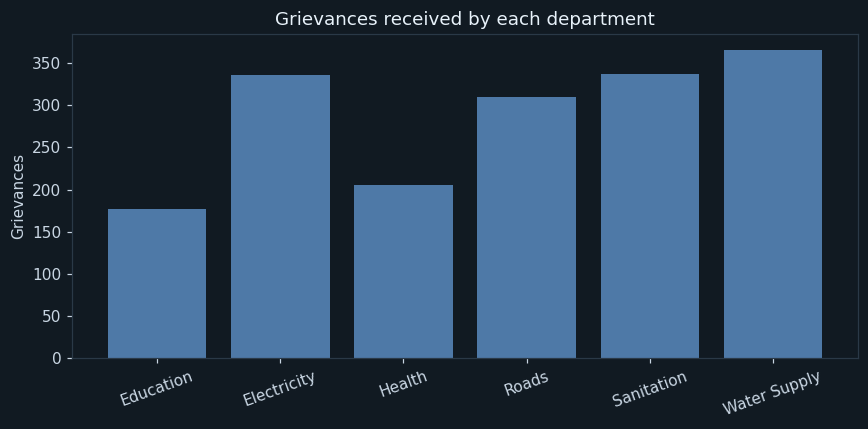
The number of grievances for each department, after cleaning.
Water Supply, Sanitation and Electricity are the busiest; Education and Health the quietest. The classes are uneven, so macro F1 is used to judge the models fairly.
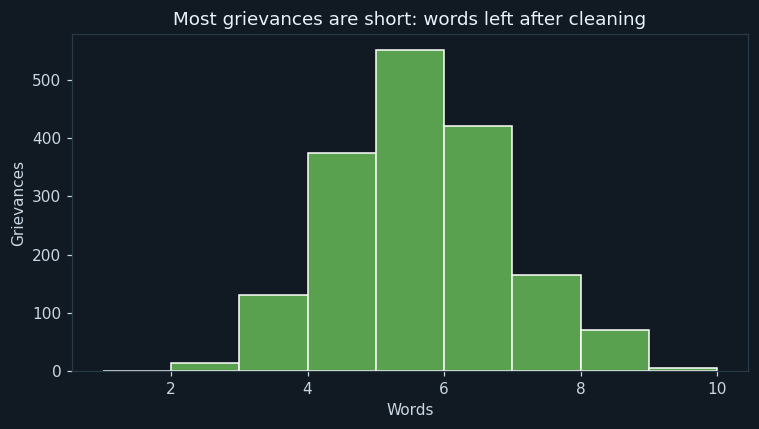
How many words each grievance has after cleaning.
Most grievances have four to seven words. The model must decide from very little text, so every word counts.
7Step 6 — Data Preparation
Removed by grievance ID, so each complaint counts once. Two different citizens writing the same words are kept — they are different grievances.
Removed: there are no words to learn from.
Stripped and put in title case, so 'ROADS' and 'roads' become 'Roads'.
Text normalisation: lowercase, punctuation removed, stop words such as 'the', 'please', 'kindly' and numbers removed.
Feature engineering
TF-IDF turns each cleaned grievance into a row of numbers, one column per word in the vocabulary — 404 words, learned from the training grievances only. A word's value is high when it appears in this grievance (term frequency) and is rare across all grievances (inverse document frequency).
The program prints one grievance's TF-IDF values: in 'low water pressure old city', 'pressure' and 'low' score highest, while 'water' scores lower because it appears in so many grievances — the IDF part at work.
Stop-word removal has a cost worth noticing: removing 'not' turns 'did not come' into 'did come'. For routing it does not matter — the department is the same — but for judging what a sentence means, it would. This is a known limit of bag-of-words.
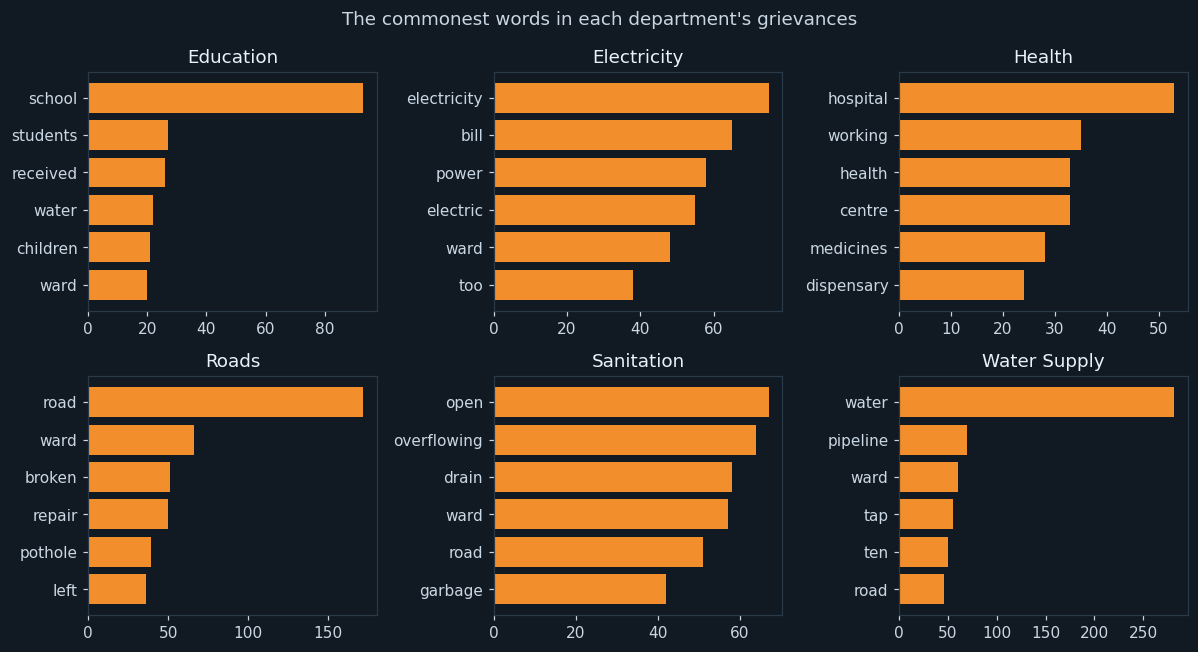
The six most frequent words in each department's cleaned grievances.
Each department has clear signal words, which is why a text model can work. Words like 'ward' and 'road' appear in several departments — the first carries no information, the second causes confusion between Roads and Sanitation.
8Step 7 — Modelling
Each past grievance has the department that handled it, so this is supervised classification into six classes.
The data is split 80 : 20 with stratify, so each department has the same share in training and testing: 1384 grievances to train on and 347 to test.
How the models work
Each model is a pipeline of two steps: TfidfVectorizer turns text into numbers, then the classifier learns. Keeping both in one pipeline means the vocabulary is learned from the training grievances only, so the test grievances stay truly unseen — and inside cross validation, from each fold's training part only.
Naive Bayes learns how often each word appears in each department. Logistic Regression learns a weight for every word for every department; for a new grievance, the department with the largest total gets the highest probability.
9Step 8 — Evaluation
On the test set, Naive Bayes routed 0.9164 of grievances correctly and Logistic Regression 0.9222; their macro F1 scores were 0.9152 and 0.9216.
Because the classes are uneven, stratified 5-fold cross validation was used to compare them fairly: mean macro F1 0.9106 for Naive Bayes and 0.9126 for Logistic Regression. The difference is small; Logistic Regression is chosen, also because its probabilities are needed for the threshold.
27 test grievances were routed wrongly. Reading them is more useful than any score: every one of them is a grievance that touches two departments — 'hospital has no electricity', 'dengue mosquitoes from blocked drain' — or a vague one like 'officials not responding about the problem', which no model could route from the words alone. These are the grievances clerks disagree about too.
The model's confidence helps. Its average highest probability was 0.799 when it was right but 0.447 when wrong. With a threshold of 0.5, 17 of 27 wrong routings would go to an officer instead, and the automatic routings would be right 0.9682 of the time.
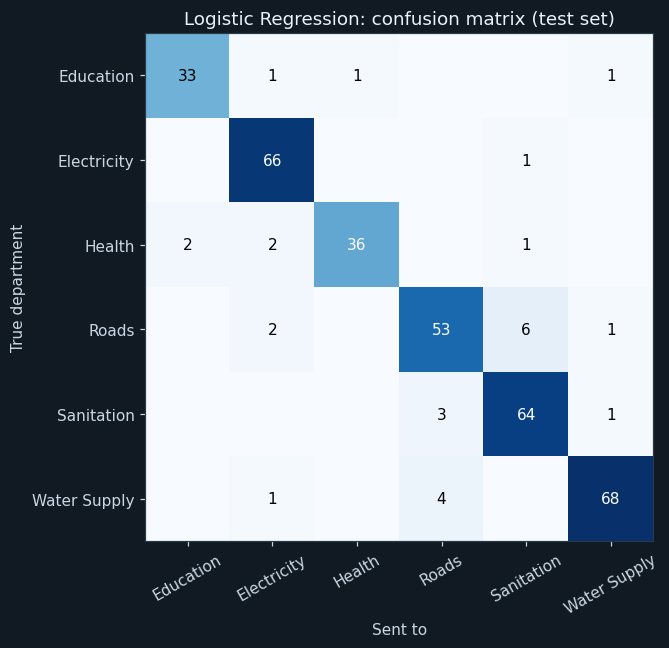
Rows are the true departments, columns where the model sent each test grievance. The diagonal is correct routings.
Most grievances sit on the diagonal. The mistakes cluster between departments that share words — Roads and Sanitation above all, then Roads and Water Supply, and Health with Electricity or Education — exactly the pairs the clerk said were judgement calls.
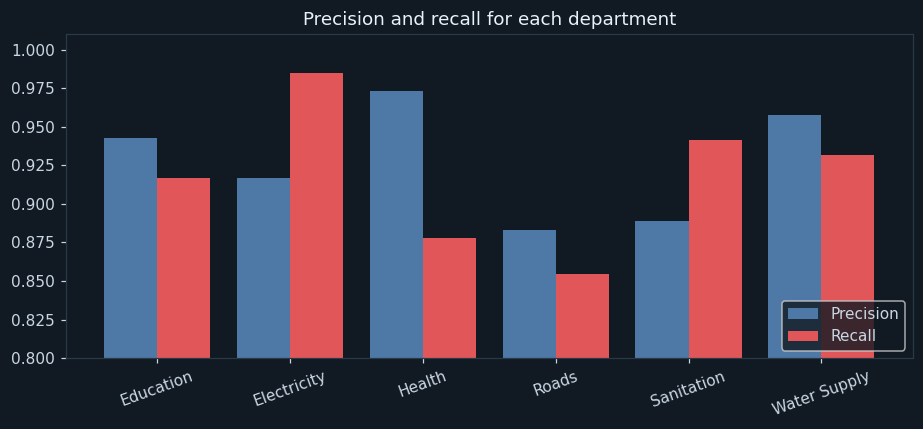
For each department, precision (of grievances sent there, how many belonged) and recall (of its grievances, how many arrived).
Roads has the lowest scores, because it shares words with Sanitation and Electricity. Health has high precision but lower recall: some health grievances mention a school, electricity or a drain and are sent there instead.
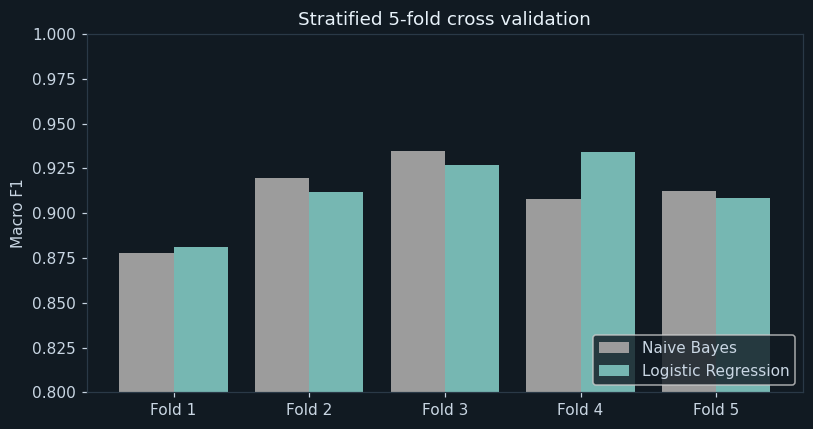
Macro F1 for both models in each of five folds, with every department in the same proportion in each fold.
The two models are very close and each wins some folds. The averages decide, narrowly, for Logistic Regression — which also gives the probabilities the threshold needs.
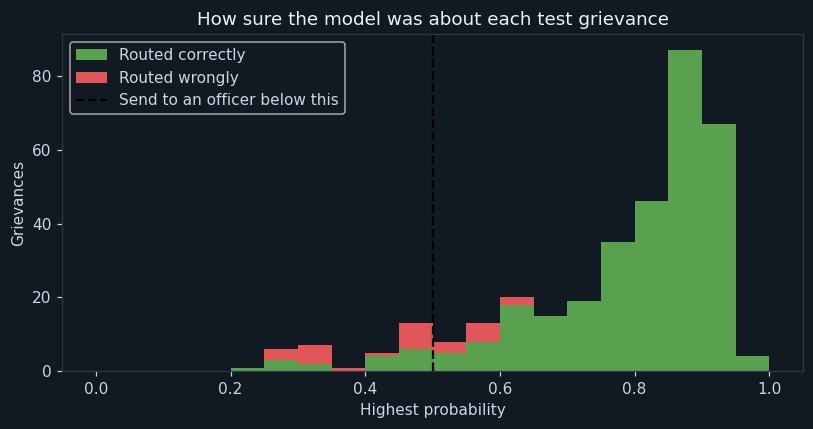
The model's highest probability for each test grievance; green were routed correctly, red wrongly. The dashed line is the 0.5 threshold.
Correct routings are mostly confident; wrong ones mostly are not. Sending everything below 0.5 to an officer removes most of the mistakes while leaving most grievances automatic.
10Step 9 — Deployment
The chosen pipeline is saved to grievance_model.pkl. As each grievance arrives, it is cleaned exactly as in training and given to the model. If the highest probability is 0.5 or more, the grievance goes straight to that department; otherwise it goes to a human officer in the grievance cell.
The program shows three: a street light (Electricity), garbage and a blocked drain (Sanitation), and a missing pension — which belongs to none of the six departments — sent to an officer because the model is unsure. A system that knows when it does not know is safer than one that always answers.
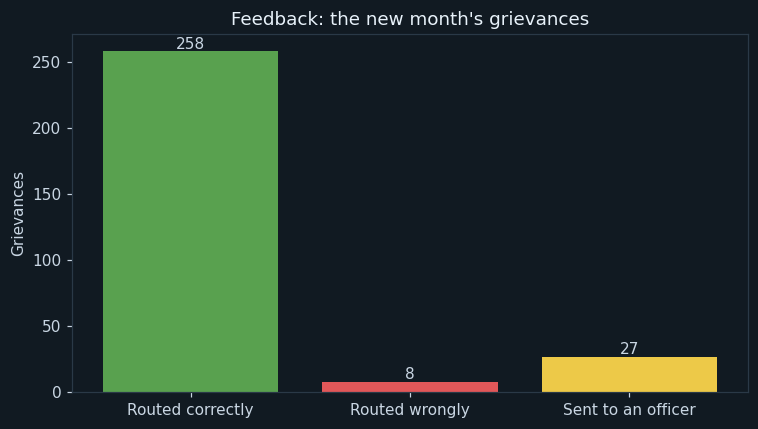
What happened to each of the new month's grievances: routed correctly, routed wrongly, or sent to an officer.
Most were routed correctly and automatically; only a few were routed wrongly. Every online-fraud grievance, a kind never seen before, went to an officer instead of being forced into the wrong department.
11Step 10 — Feedback
The new month brought 293 grievances. 266 were routed automatically and 27 sent to an officer; of the automatic routings, 258 of 266 were correct.
The month included grievances about online fraud — a department the model has never seen. All of them went to an officer (6 of 6). That is the threshold doing its job, but it is also a signal: when officers keep receiving the same new kind of grievance, a new department (here, the cyber cell) should be added, and the model retrained with those examples.
The feedback loop is the officers themselves: every grievance an officer routes by hand, and every wrong routing a department sends back, becomes a new labelled example for the next retraining.
12Ethical considerations
Grievances can contain names, phone numbers and addresses. These must be removed before the text is used for training, and the model kept within the government's systems.
Citizens who write in another language, or with many spelling mistakes, must not be routed worse. The officer threshold catches unclear grievances, and mistakes should be checked by language and region.
Routing speeds up a grievance; it does not decide it. Departments remain responsible for resolving complaints, and a citizen can always ask for a review.
Citizens should be told that routing is automatic and that they can ask for a human review if it seems wrong.
13Source code
The whole program, laid out as the ten steps of the methodology. Every chart and number on this page came out of running it.
# ---------------------------------------------------------------------------
# grievance_desk.py
#
# Capstone project: a grievance desk that reads each citizen's complaint and
# sends it to the right department, so it is not left waiting in a pile.
#
# CBSE Class XII, Artificial Intelligence (843), Part C - Capstone Project.
# SDG 16 (Peace, Justice and Strong Institutions).
#
# Data Science Methodology, 10 steps. NATURAL LANGUAGE PROCESSING: the text
# is cleaned, turned into numbers with TF-IDF, and classified into six
# departments. Naive Bayes is compared with Logistic Regression, with
# stratified 5-fold cross validation. Grievances the model is unsure about
# go to a human officer.
#
# Libraries: pandas, numpy, matplotlib, scikit-learn, joblib.
# ---------------------------------------------------------------------------

# %% Step 1 - Business Understanding
print("=" * 64)
print("THE GRIEVANCE DESK")
print("=" * 64)
print("Problem : grievances wait for days before someone reads them and")
print("          forwards them to the right department")
print("Goal    : read each grievance and route it at once; send the")
print("          unclear ones to a human officer")
print()

# %% Step 2 - Analytic Approach
print("Analytic approach : predictive - text classification into 6 departments")
print()

# %% Step 3 - Data Requirements
import string
import pandas as pd
import numpy as np
import matplotlib.pyplot as plt
from sklearn.feature_extraction.text import TfidfVectorizer
from sklearn.naive_bayes import MultinomialNB
from sklearn.linear_model import LogisticRegression
from sklearn.pipeline import make_pipeline
from sklearn.model_selection import train_test_split, StratifiedKFold, cross_val_score
from sklearn.metrics import accuracy_score, confusion_matrix, precision_score, recall_score, f1_score
import joblib

# %% Step 4 - Data Collection
data = pd.read_csv("grievances.csv", keep_default_na=False)
print("Grievances collected :", len(data))
print()

# %% Step 5 - Data Understanding
print("--- Step 5: Data Understanding ---")
print("Department names as typed:")
print(data["department"].value_counts().to_string())
print()

# %% Step 6 - Data Preparation
print("--- Step 6: Data Preparation ---")
before = len(data)
data = data.drop_duplicates(subset="id")
print("Grievances submitted twice, removed :", before - len(data))
blank = data["grievance"].str.strip() == ""
print("Blank grievances removed            :", int(blank.sum()))
data = data[~blank].copy()
data["department"] = data["department"].str.strip().str.title()
print("Department names after fixing case  :", data["department"].nunique())

STOP = {"a", "an", "the", "in", "on", "at", "of", "to", "is", "are", "and", "for", "from", "near",
        "my", "our", "this", "it", "by", "has", "was", "very", "please", "kindly", "since",
        "so", "no", "not", "we", "nobody", "again", "every", "last", "take", "action", "help",
        "soon", "solve", "urgent", "request", "quick", "listening", "be", "days", "week", "month"}


def clean(text):
    text = text.lower()
    for mark in string.punctuation:
        text = text.replace(mark, " ")
    words = [w for w in text.split() if w not in STOP and not w.isdigit()]
    return " ".join(words)


data["clean"] = data["grievance"].apply(clean)
print("Example before cleaning :", data["grievance"].iloc[2])
print("Example after cleaning  :", data["clean"].iloc[2])
data["words"] = data["clean"].str.split().str.len()
print("Average words per grievance after cleaning :", round(data["words"].mean(), 1))
print()

depts = sorted(data["department"].unique())
counts = data["department"].value_counts().reindex(depts)
print("Grievances per department:")
print(counts.to_string())
print()

# Chart 1: grievances per department.
plt.figure(figsize=(8, 4))
plt.bar(depts, counts.values, color="#4e79a7")
plt.title("Grievances received by each department")
plt.ylabel("Grievances")
plt.xticks(rotation=20)
plt.tight_layout()
plt.savefig("chart1_departments.png")
plt.close()

# Chart 2: how long the grievances are.
plt.figure(figsize=(7, 4))
plt.hist(data["words"], bins=range(1, data["words"].max() + 2), color="#59a14f", edgecolor="white")
plt.title("Most grievances are short: words left after cleaning")
plt.xlabel("Words")
plt.ylabel("Grievances")
plt.tight_layout()
plt.savefig("chart2_lengths.png")
plt.close()

# Chart 3: the commonest words in each department.
plt.figure(figsize=(11, 6))
for k, d in enumerate(depts):
    words = " ".join(data[data["department"] == d]["clean"]).split()
    top = pd.Series(words).value_counts().head(6)
    plt.subplot(2, 3, k + 1)
    plt.barh(top.index[::-1], top.values[::-1], color="#f28e2b")
    plt.title(d)
plt.suptitle("The commonest words in each department's grievances")
plt.tight_layout()
plt.savefig("chart3_top_words.png")
plt.close()

# %% Step 7 - Modelling
print("--- Step 7: Modelling ---")
X_train, X_test, y_train, y_test = train_test_split(
    data["clean"], data["department"], test_size=0.2, stratify=data["department"], random_state=4)
print("Training grievances :", len(X_train))
print("Testing grievances  :", len(X_test))
bayes = make_pipeline(TfidfVectorizer(), MultinomialNB())
logistic = make_pipeline(TfidfVectorizer(), LogisticRegression(max_iter=2000))
bayes.fit(X_train, y_train)
logistic.fit(X_train, y_train)
vocab = bayes.named_steps["tfidfvectorizer"].get_feature_names_out()
print("Vocabulary learned (distinct words) :", len(vocab))
example = bayes.named_steps["tfidfvectorizer"].transform([X_train.iloc[0]])
print("TF-IDF example :", X_train.iloc[0])
for j in example.nonzero()[1]:
    print("   ", vocab[j], ":", round(example[0, j], 3))
print()

# %% Step 8 - Evaluation
print("--- Step 8: Evaluation ---")
pred_b = bayes.predict(X_test)
pred_l = logistic.predict(X_test)
print("Accuracy, Naive Bayes         :", round(accuracy_score(y_test, pred_b), 4))
print("Accuracy, Logistic Regression :", round(accuracy_score(y_test, pred_l), 4))
print("Macro F1, Naive Bayes         :", round(f1_score(y_test, pred_b, average="macro"), 4))
print("Macro F1, Logistic Regression :", round(f1_score(y_test, pred_l, average="macro"), 4))
folds = StratifiedKFold(n_splits=5, shuffle=True, random_state=1)
cv_b = cross_val_score(make_pipeline(TfidfVectorizer(), MultinomialNB()), data["clean"], data["department"],
                       cv=folds, scoring="f1_macro")
cv_l = cross_val_score(make_pipeline(TfidfVectorizer(), LogisticRegression(max_iter=2000)), data["clean"],
                       data["department"], cv=folds, scoring="f1_macro")
print("Macro F1 in each fold, Naive Bayes         :", np.round(cv_b, 3))
print("Macro F1 in each fold, Logistic Regression :", np.round(cv_l, 3))
print("Mean CV macro F1, Naive Bayes         :", round(cv_b.mean(), 4))
print("Mean CV macro F1, Logistic Regression :", round(cv_l.mean(), 4))
best_name = "Logistic Regression" if cv_l.mean() >= cv_b.mean() else "Naive Bayes"
best = logistic if best_name == "Logistic Regression" else bayes
pred = pred_l if best_name == "Logistic Regression" else pred_b
print("Chosen model :", best_name)
print()

prec = precision_score(y_test, pred, labels=depts, average=None)
rec = recall_score(y_test, pred, labels=depts, average=None)
print("Department      precision  recall")
for d, p, r in zip(depts, prec, rec):
    print(f"{d:<15} {p:9.3f} {r:7.3f}")
print()
wrong = [i for i in range(len(y_test)) if pred[i] != y_test.iloc[i]]
print("Grievances sent to the wrong department (test set) :", len(wrong))
print("The first eight:")
for i in wrong[:8]:
    print("  ", repr(data.loc[y_test.index[i], "grievance"]), "| true:", y_test.iloc[i], "| sent to:", pred[i])
print()

# Chart 4: the confusion matrix.
cm = confusion_matrix(y_test, pred, labels=depts)
plt.figure(figsize=(7, 6))
plt.imshow(cm, cmap="Blues")
for a in range(len(depts)):
    for b in range(len(depts)):
        if cm[a, b] > 0:
            plt.text(b, a, cm[a, b], ha="center", va="center",
                     color="white" if cm[a, b] > cm.max() / 2 else "black")
plt.xticks(range(len(depts)), depts, rotation=30)
plt.yticks(range(len(depts)), depts)
plt.xlabel("Sent to")
plt.ylabel("True department")
plt.title(best_name + ": confusion matrix (test set)")
plt.tight_layout()
plt.savefig("chart4_confusion.png")
plt.close()

# Chart 5: precision and recall for each department.
x = np.arange(len(depts))
plt.figure(figsize=(8.5, 4))
plt.bar(x - 0.2, prec, width=0.4, label="Precision", color="#4e79a7")
plt.bar(x + 0.2, rec, width=0.4, label="Recall", color="#e15759")
plt.xticks(x, depts, rotation=20)
plt.ylim(0.8, 1.01)
plt.title("Precision and recall for each department")
plt.legend(loc="lower right")
plt.tight_layout()
plt.savefig("chart5_per_department.png")
plt.close()

# Chart 6: macro F1 in each fold.
x = np.arange(5)
plt.figure(figsize=(7.5, 4))
plt.bar(x - 0.2, cv_b, width=0.4, label="Naive Bayes", color="#9c9c9c")
plt.bar(x + 0.2, cv_l, width=0.4, label="Logistic Regression", color="#76b7b2")
plt.xticks(x, ["Fold 1", "Fold 2", "Fold 3", "Fold 4", "Fold 5"])
plt.ylim(0.8, 1.0)
plt.ylabel("Macro F1")
plt.title("Stratified 5-fold cross validation")
plt.legend(loc="lower right")
plt.tight_layout()
plt.savefig("chart6_kfold.png")
plt.close()

# How sure is the model? Its highest probability for each test grievance.
sure = best.predict_proba(X_test).max(axis=1)
right = pred == y_test.values
print("Average confidence when right :", round(sure[right].mean(), 3))
if (~right).sum() > 0:
    print("Average confidence when wrong :", round(sure[~right].mean(), 3))
else:
    print("Average confidence when wrong : none were wrong")
THRESHOLD = 0.5
print("Test grievances below", THRESHOLD, "confidence :", int((sure < THRESHOLD).sum()))
print("Wrong routings caught by the threshold :", int((~right & (sure < THRESHOLD)).sum()), "of", int((~right).sum()))
auto_test = sure >= THRESHOLD
print("Accuracy of the automatic routings :", round(right[auto_test].mean(), 4))
print()

# Chart 7: confidence of right and wrong routings.
plt.figure(figsize=(7.5, 4))
plt.hist([sure[right], sure[~right]], bins=np.linspace(0, 1, 21), stacked=True,
         color=["#59a14f", "#e15759"], label=["Routed correctly", "Routed wrongly"])
plt.axvline(THRESHOLD, color="black", linestyle="--", label="Send to an officer below this")
plt.title("How sure the model was about each test grievance")
plt.xlabel("Highest probability")
plt.ylabel("Grievances")
plt.legend(loc="upper left")
plt.tight_layout()
plt.savefig("chart7_confidence.png")
plt.close()

# %% Step 9 - Deployment
print("--- Step 9: Deployment ---")
joblib.dump(best, "grievance_model.pkl")
model = joblib.load("grievance_model.pkl")


def route(text):
    cleaned = clean(text)
    probs = model.predict_proba([cleaned])[0]
    top = probs.argmax()
    if probs[top] < THRESHOLD:
        return "Human officer", probs[top]
    return model.classes_[top], probs[top]


for text in ["The street light outside my house is not working for a week",
             "Garbage is lying on the road and the drain is blocked",
             "My pension has not come for two months"]:
    dept, p = route(text)
    print(repr(text), "->", dept, "(confidence", str(round(p, 2)) + ")")
print()

# %% Step 10 - Feedback
print("--- Step 10: Feedback ---")
new = pd.read_csv("new_month.csv", keep_default_na=False)
print("Grievances in the new month :", len(new))
sent = [route(t)[0] for t in new["grievance"]]
new["sent_to"] = sent
known = new["department"].isin(model.classes_)
auto = new["sent_to"] != "Human officer"
print("Routed automatically        :", int(auto.sum()))
print("Sent to a human officer     :", int((~auto).sum()))
print("Automatic routings correct  :", int((new["sent_to"] == new["department"])[auto].sum()), "of", int(auto.sum()))
print("Departments never seen in training :", sorted(new.loc[~known, "department"].unique()))
print("Of these grievances, sent to an officer :", int((~auto & ~known).sum()), "of", int((~known).sum()))
for i in new.index[~known]:
    print("  ", repr(new.loc[i, "grievance"]), "->", new.loc[i, "sent_to"])

# Chart 8: what happened to the new month's grievances.
outcome = pd.Series(np.where(~auto, "Sent to an officer",
                    np.where(new["sent_to"] == new["department"], "Routed correctly", "Routed wrongly")))
outcome = outcome.value_counts().reindex(["Routed correctly", "Routed wrongly", "Sent to an officer"], fill_value=0)
plt.figure(figsize=(7, 4))
plt.bar(outcome.index, outcome.values, color=["#59a14f", "#e15759", "#edc948"])
for k, v in enumerate(outcome.values):
    plt.text(k, v + 2, str(v), ha="center")
plt.title("Feedback: the new month's grievances")
plt.ylabel("Grievances")
plt.tight_layout()
plt.savefig("chart8_new_month.png")
plt.close()
The library calls it is built from
| Call | Step | What it does |
|---|---|---|
pd.read_csv(keep_default_na=False) | Step 4 | Reads blank grievances as empty text, not NaN |
drop_duplicates(subset="id") | Step 6 | Removes grievances submitted twice |
str.strip().str.title() | Step 6 | Fixes the case of department names |
clean(): lower, punctuation, stop words | Step 6 | Text normalisation |
TfidfVectorizer() | Steps 6–7 | Turns text into TF-IDF numbers |
make_pipeline(TfidfVectorizer(), MultinomialNB()) | Step 7 | The Naive Bayes text classifier |
make_pipeline(TfidfVectorizer(), LogisticRegression()) | Step 7 | The Logistic Regression text classifier |
StratifiedKFold + cross_val_score(scoring="f1_macro") | Step 8 | Fair comparison across uneven departments |
predict_proba().max() | Steps 8–9 | The model's confidence, for the officer threshold |
joblib.dump() / load() | Step 9 | Saves and reloads the pipeline |
14Output of a real run
================================================================
THE GRIEVANCE DESK
================================================================
Problem : grievances wait for days before someone reads them and
          forwards them to the right department
Goal    : read each grievance and route it at once; send the
          unclear ones to a human officer

Analytic approach : predictive - text classification into 6 departments

Grievances collected : 1752

--- Step 5: Data Understanding ---
Department names as typed:
department
Water Supply    364
Sanitation      341
Electricity     339
Roads           311
Health          206
Education       177
roads             4
ELECTRICITY       3
SANITATION        2
WATER SUPPLY      2
education         1
water supply      1
health            1

--- Step 6: Data Preparation ---
Grievances submitted twice, removed : 12
Blank grievances removed            : 9
Department names after fixing case  : 6
Example before cleaning : Water tanker did not come to nehru park area. please help
Example after cleaning  : water tanker did come nehru park area
Average words per grievance after cleaning : 5.2

Grievances per department:
department
Education       177
Electricity     336
Health          205
Roads           310
Sanitation      337
Water Supply    366

--- Step 7: Modelling ---
Training grievances : 1384
Testing grievances  : 347
Vocabulary learned (distinct words) : 404
TF-IDF example : low water pressure old city
    city : 0.416
    low : 0.529
    old : 0.416
    pressure : 0.536
    water : 0.295

--- Step 8: Evaluation ---
Accuracy, Naive Bayes         : 0.9164
Accuracy, Logistic Regression : 0.9222
Macro F1, Naive Bayes         : 0.9152
Macro F1, Logistic Regression : 0.9216
Macro F1 in each fold, Naive Bayes         : [0.878 0.92  0.935 0.908 0.912]
Macro F1 in each fold, Logistic Regression : [0.881 0.912 0.927 0.934 0.909]
Mean CV macro F1, Naive Bayes         : 0.9106
Mean CV macro F1, Logistic Regression : 0.9126
Chosen model : Logistic Regression

Department      precision  recall
Education           0.943   0.917
Electricity         0.917   0.985
Health              0.973   0.878
Roads               0.883   0.855
Sanitation          0.889   0.941
Water Supply        0.958   0.932

Grievances sent to the wrong department (test set) : 27
The first eight:
   'street light not working and road is dark and broken in block c. kindly take action' | true: Roads | sent to: Electricity
   'Pothole filled with sewer paani in sector 4. we request quick action!!' | true: Sanitation | sent to: Roads
   'hospital has no electricity for three days. nobody is listening' | true: Health | sent to: Electricity
   'Naali watr flooding the sadak in our colony. nobody is listening' | true: Roads | sent to: Sanitation
   'road dug for paani pipeline and left open in ward 12. nobody is listening' | true: Water Supply | sent to: Roads
   'Officials not responding about the problem in our colony. kindly take action' | true: Water Supply | sent to: Electricity
   'dengue mosquitoes from blocked drain in block c. kindly take action' | true: Health | sent to: Sanitation
   'dirty water in the school tap in shanti vihar. nobody is listening' | true: Education | sent to: Water Supply

Average confidence when right : 0.799
Average confidence when wrong : 0.447
Test grievances below 0.5 confidence : 33
Wrong routings caught by the threshold : 17 of 27
Accuracy of the automatic routings : 0.9682

--- Step 9: Deployment ---
'The street light outside my house is not working for a week' -> Electricity (confidence 0.73)
'Garbage is lying on the road and the drain is blocked' -> Sanitation (confidence 0.83)
'My pension has not come for two months' -> Human officer (confidence 0.42)

--- Step 10: Feedback ---
Grievances in the new month : 293
Routed automatically        : 266
Sent to a human officer     : 27
Automatic routings correct  : 258 of 266
Departments never seen in training : ['Cyber Crime']
Of these grievances, sent to an officer : 6 of 6
   'money taken from my bank account by an online fraud call' -> Human officer
   'fake website took my payment' -> Human officer
   'online shopping fraud, money not returned' -> Human officer
   'someone asked my otp on phone and took money' -> Human officer
   'my upi was used by a stranger' -> Human officer
'fake job offer message took registration money' -> Human officer15The same project in Orange
Orange's Text Mining add-on has the same steps as widgets: preprocessing, bag of words with TF-IDF, and classifiers. The tool is Orange Data Mining (Text add-on).
| Widget | What it does |
|---|---|
| Corpus | Load grievances.csv; use 'grievance' as the text and 'department' as the target. |
| Preprocess Text | Lowercase, remove punctuation, and filter stop words. |
| Bag of Words | Choose TF-IDF as the term frequency weighting. |
| Naive Bayes and Logistic Regression | Connect both to Test and Score. |
| Test and Score | Choose stratified 5-fold cross validation; compare F1. |
| Confusion Matrix | See which departments are confused, and click a cell to read the grievances. |
16Testing
Every case was run: each gives the whole program a small input of its own.
| Test case | Expected | Actual | Result |
|---|---|---|---|
| Every grievance read | Grievances collected : 1752 | Grievances collected : 1752 | Pass |
| Department names typed in other cases are merged | Department names after fixing case : 6 | Department names after fixing case : 6 | Pass |
| Cross validation picks the better text model | Chosen model : Logistic Regression | Chosen model : Logistic Regression | Pass |
| A grievance about no known department goes to a person | 'My pension has not come for two months' -> Human officer (confidence 0.42) | 'My pension has not come for two months' -> Human officer (confidence 0.42) | Pass |
| Every grievance of a never-seen kind goes to an officer | Of these grievances, sent to an officer : 6 of 6 | Of these grievances, sent to an officer : 6 of 6 | Pass |
| Clear, distinct words: every test grievance routed right | Accuracy, Logistic Regression : 1.0 | Accuracy, Logistic Regression : 1.0 | Pass |
| Four blank grievances are removed | Blank grievances removed : 4 | Blank grievances removed : 4 | Pass |
| Three grievances submitted twice are removed | Grievances submitted twice, removed : 3 | Grievances submitted twice, removed : 3 | Pass |
| Upper-case department names are fixed | Department names after fixing case : 6 | Department names after fixing case : 6 | Pass |
| The data file is missing | FileNotFoundError: [Errno 2] No such file or directory: 'grievances.csv' | FileNotFoundError: [Errno 2] No such file or directory: 'grievances.csv' | Pass |
17Team roles and timeline
A capstone is done by a group of 3 to 5. A suggested split of the work, and a timeline across the year:
| Role | Responsible for |
|---|---|
| Project lead | Business understanding; interviews with the clerk, officers and citizens |
| Data lead | Exporting grievances; removing personal details |
| Text analyst | Text normalisation, stop words and TF-IDF |
| Modeller | The two classifiers, cross validation and the threshold |
| Documentation and video | The report, the feedback month, and the 3-minute video |
| When | Methodology steps | Deliverable |
|---|---|---|
| July | 1 Business Understanding, 2 Analytic Approach | Problem statement; interviews at the grievance cell |
| August | 3 Data Requirements, 4 Data Collection | Grievances exported and anonymised |
| September | 5 Data Understanding, 6 Data Preparation | Text cleaned; TF-IDF built |
| October | 7 Modelling, 8 Evaluation | Models compared; mistakes read one by one |
| November | 9 Deployment, 10 Feedback | Threshold set; a new month tested |
| December – January | Documentation and video | Report and 3-minute video |
18Results, limits and what next
- Text can be routed by its words: both models route about nine grievances in ten correctly.
- Cross validation found the two models close — mean macro F1 0.9106 against 0.9126.
- The mistakes are grievances about two departments, or vague ones — the same ones clerks disagree on.
- A 0.5 confidence threshold catches 17 of 27 mistakes and leaves the automatic routings 0.9682 accurate.
- A new kind of complaint (online fraud) went to officers every time, instead of the wrong department.
Limitations
- Sample grievances written from templates, for six departments only
- Bag-of-words ignores word order and negation
- Grievances in other Indian languages are not handled
- Some labels are judgement calls, which limits any model
Future scope
- Grievances in Hindi and other Indian languages
- Add new departments, such as the cyber cell, as feedback shows the need
- Also predict urgency, so a sparking transformer is handled before a bill query
- Let a grievance go to two departments when it is about both
What the team had to learn
- Text normalisation: tokens, stop words, punctuation
- Bag of words and TF-IDF, in scikit-learn
- Naive Bayes for text
- Macro F1 for uneven classes
- Confidence thresholds and human-in-the-loop systems
19Conclusion
The capstone built a grievance desk that reads complaints in citizens' own words and routes about nine in ten correctly — and, with a confidence threshold, routes the clear ones almost without error while sending the unclear ones to a person.
Reading the mistakes taught more than the scores. They were grievances that belong to two departments, or say too little — the cases where people disagree too. A model cannot be more certain than the labels it learns from.
The most useful design choice was letting the model say 'I am not sure'. It kept a new kind of grievance out of the wrong department, and showed the city that a new department was needed.
20The 3-minute video script
Part C asks for a video of exactly three minutes with six parts. A script, timed to the second:
| Time | Part | What to say and show |
|---|---|---|
| 0:00 – 0:25 | a. Problem statement | Show a pile of complaints. "Every grievance waits for someone to read it and forward it. Some wait days." |
| 0:25 – 0:40 | b. SDG alignment | SDG 16 icon. "Responsive, accountable institutions — starting with reading every complaint quickly." |
| 0:40 – 1:15 | c. AI concepts and algorithms | "Natural language processing: cleaning text, TF-IDF, and two classifiers — Naive Bayes and Logistic Regression — compared with stratified 5-fold cross validation." |
| 1:15 – 2:15 | d. How it works | Type a grievance, show it cleaned, then routed. Then chart 7: confident routings go straight through, unsure ones to an officer. Then the fraud grievances going to an officer. |
| 2:15 – 2:45 | e. Conclusion | "Nine in ten routed correctly — and the model knows when to ask a person." |
| 2:45 – 3:00 | f. Acknowledgement | "We thank our AI teacher, [name], and the grievance cell staff who helped us." |
21Questions for the viva
▸Why must text be cleaned before modelling?
So that 'Water', 'water' and 'water!!' count as the same word, and filler words like 'please' do not take up the model's attention.
▸What is TF-IDF?
A value for each word in a document: high when the word is frequent in that document but rare across all documents.
▸Why did 'water' get a lower TF-IDF value than 'pressure'?
Because 'water' appears in many grievances, so its inverse document frequency is low.
▸Why macro F1 and not accuracy?
The departments have uneven numbers of grievances; macro F1 averages each department's F1, so a small department that is badly served still pulls the score down.
▸Why put TfidfVectorizer inside the pipeline?
So that the vocabulary is learned only from the training data, in every fold, and the test grievances remain unseen.
▸What does the confidence threshold do?
Grievances the model is less than 50% sure about go to a human officer instead of being guessed.
▸Why did the model make mistakes?
Most were grievances about two departments, or vague ones — cases where even clerks disagree.
▸Which SDG does it align to?
SDG 16, Peace, Justice and Strong Institutions — targets 16.6 and 16.7 on effective and responsive institutions.
22References
- CPGRAMS — Centralised Public Grievance Redress and Monitoring System, DARPG — https://pgportal.gov.in/
- Department of Administrative Reforms and Public Grievances — https://darpg.gov.in/
- scikit-learn: Working with text data — https://scikit-learn.org/stable/tutorial/text_analytics/working_with_text_data.html
- CBSE Class X AI — Natural Language Processing (bag of words and TF-IDF)
- CBSE, Artificial Intelligence (Subject Code 843), Class XII curriculum, 2026-27 — Part C
- CBSE, Artificial Intelligence Student Handbook, Class XII — Unit 2, Data Science Methodology
- Rollins, J. B. (2015). Foundational Methodology for Data Science. IBM Analytics.
- scikit-learn — https://scikit-learn.org/stable/; pandas, NumPy and Matplotlib documentation
- LambdaLab — https://www.lambdalab.in